
Panama City Directory Shelves
Panama City city directory research begins with a coverage check. The Bay County Public Library describes a local run from 1935 to the present, while Florida Hidden Treasures offers two verified scanned volumes. Selected reverse-directory years are documented in official city environmental research. The research did not verify a copy for every year, a complete publisher succession, or the final printed year.
| Collection | Years | Where held | Access |
|---|---|---|---|
| Panama City city directories | 1935 to present, collection-level claim | Bay County Public Library Local History Room | Room use, weekdays 9:00 to 4:30 |
| Greater Panama City / Panama City scans | 1938 and 1943 | Florida Hidden Treasures | Free online page images |
| Polk reverse-directory evidence | 1953, 1959, 1965, 1969, 1973, 1975, 1980, 1985 | Cited in official city research | Address searches documented; shelf for each year unverified |
| EDR reverse listings | 1992, 1995, 2000, 2005, 2010, 2014, 2017 | Commercial archive cited by the city | Terms vary |
| Panama City Pilot | 1907 to 1941, 25 reels | Library Genealogy Collection | Room microfilm |
| Federal census | Public schedules through 1950 | NARA and library genealogy access | Free 1950 site and affiliate resources |
The phrase “1935 to present” describes the whole library collection. It does not establish that every annual city directory survives. Ask staff to confirm the target year before planning a visit, and keep the volume title and page with every transcription.
Panama City Local History Room
The Northwest Regional Library System genealogy collection centers local research at Bay County Public Library, 898 W 11th Street. The Local History Room is staffed Monday through Friday from 9:00 to 4:30. Researchers can call 850-522-2132 or email genealogy@nwrls.com. The materials do not circulate, so allow time to inspect books and microfilm in the room.
Its scale makes the library more than a directory shelf: more than 5,000 genealogy books, over 2,000 microfilm rolls, more than 200 maps, and over 10,000 local photographs. Holdings also include telephone books, school yearbooks, newspapers, family and organization vertical files, and the Panama City Pilot on microfilm. These companions help when a city directory year is absent or a person appears under an unexpected spelling.
The library's genealogy service page shows the research entry point and collection scope.
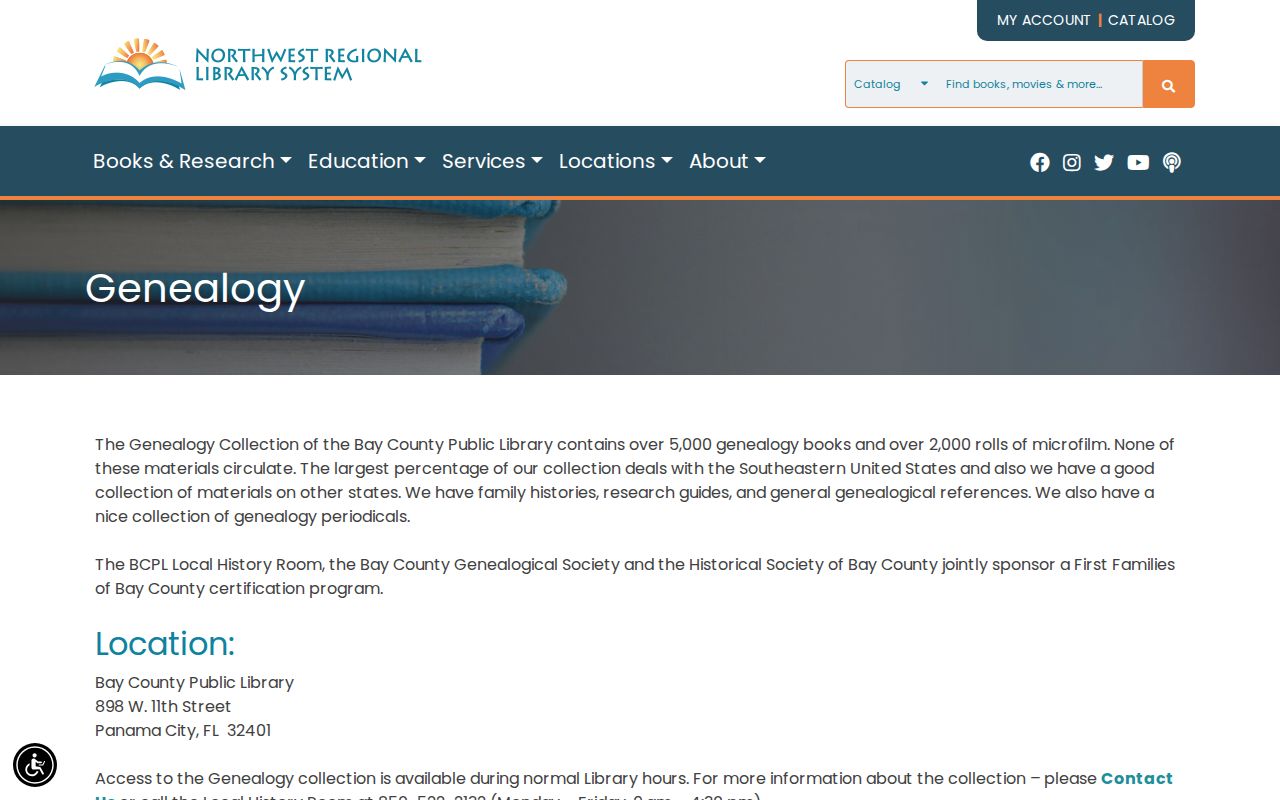
The screen confirms where to begin before contacting staff for a specific directory year or restricted FamilySearch image.
Open Panama City Directory Scans
Florida Hidden Treasures provides free images for the verified 1938 and 1943 directory books. Browse the volume rather than relying only on a catalog hit. Capture the title page, abbreviation or explanatory pages, the alphabetical entry, and any street-order result that bears on the same address.
The collection view displays the digitized directory set available for Panama City research.
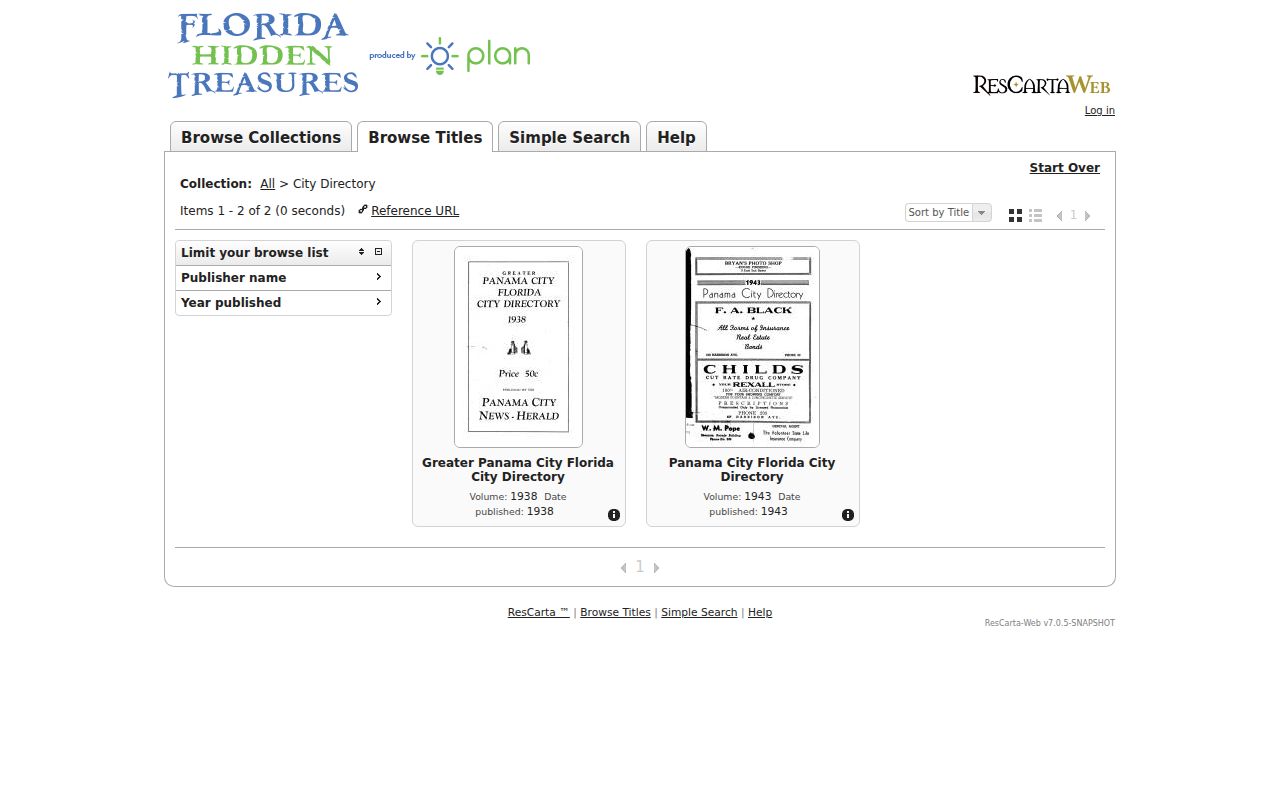
Those two verified online editions form fixed points around World War II. A claim about another year should come from the physical shelf, a catalog record, or a cited local study.
Archive metadata names H. Earl Humbert and “Panama City News-Hearld,” using the archive's spelling, as publisher facets. The research did not map each name to a volume by title-page inspection. Keep that uncertainty instead of assigning a publisher to a year by guess.
Read Panama City Directory Entries
Local evidence shows how varied an entry can be. A 1935 Glenwood planning source reproduces businesses with a name, type, and owner, including Blue Front Café as a restaurant associated with James Dennis and Wells Café/Barber Shop with J. W. Wells. Examples from 1948 pair businesses or people with full street addresses. Those verified examples do not establish that every Panama City city directory used the same household symbols.
| Entry detail | Copy the complete printed name or business name, including spelling and initials. |
|---|---|
| Role or type | Record the occupation, business type, or owner wording exactly when shown. |
| Street address | Preserve the house number, street form, and any section marker. |
| Edition evidence | Write down year, volume title, page, and alphabetical or reverse section. |
| Legend marks | Interpret symbols only after checking that edition's key. |
A typical American directory may use spouse, widow, occupation, employer, or residence abbreviations. That does not prove the Panama City volume in hand does so. Photograph or transcribe its own abbreviation key first.
- Criss-cross directory
- A section ordered by address, useful for finding a listed occupant or business at a known place.
- Householder index
- An address-oriented list of the person treated by the publisher as the main listing at a home.
- Abbreviation key
- The volume's own guide to shortened words, symbols, and entry conventions.
- Alphabetical section
- The surname-order portion used to move from a known name to a listed address.
Trace Panama City Families
A city directory can fill the years between federal censuses. It is strongest when several editions show a consistent sequence. Start close to a known event, then move both forward and backward. Record the whole entry each time so a new address, spouse reference, occupation, or disappearance is visible.
- Search the surname and spelling variants in the closest available alphabetical edition.
- Save the full entry, page, edition title, and legend meaning, not only the street address.
- Check the reverse section for other listings at the address, then repeat in the prior and next available editions.
- Pair directory evidence near 1935, 1938, 1943, or 1948 with the 1940 and 1950 public census schedules.
- If the name vanishes, test obituaries, probate, cemetery indexes, newspapers, and the next directory rather than assuming a move.
Census schedules name a household at one decennial moment. A directory reflects its own canvass and publication cycle, which can lag a move. Agreement between both is useful, while a conflict calls for more dates and sources.
Note: The 1950 census is the newest public federal population schedule in 2026; later directory listings cannot be checked against closed schedules.
Search Panama City Before 1926
Historic geography changes the index path. St. Andrews incorporated in 1908, Millville in 1913, and the three communities consolidated in 1926. A pre-consolidation resident may appear under St. Andrews or Millville rather than Panama City even when the modern place is inside today's city. Search all three headings before calling the trail cold.
This is the Profile 3 geography interest layer in its most useful form. Millville grew around lumber and shipbuilding, while St. Andrews developed much earlier near the bay. Panama City grew between them as a port, rail center, and county seat. Separate newspaper titles and map sheets can preserve names that a citywide query misses.
| Year or span | Directory and place context |
|---|---|
| 1907–1941 | Panama City Pilot microfilm offers notices and names around early directory gaps. |
| 1917 | Four-sheet Sanborn map records the built setting, not a resident roster. |
| 1926 | Panama City, St. Andrews, and Millville consolidate. |
| 1927 | Eighteen-sheet Sanborn map gives broader street and building context. |
| 1935 onward | Library's stated Panama City directory run begins. |
| 1938 and 1943 | Verified volumes are available as free digital images. |
Panama City Directory Companions
The library's local-history collection adds yearbooks, old telephone books, maps, photographs, local newspapers, and vertical files on families, schools, churches, businesses, clubs, and organizations.
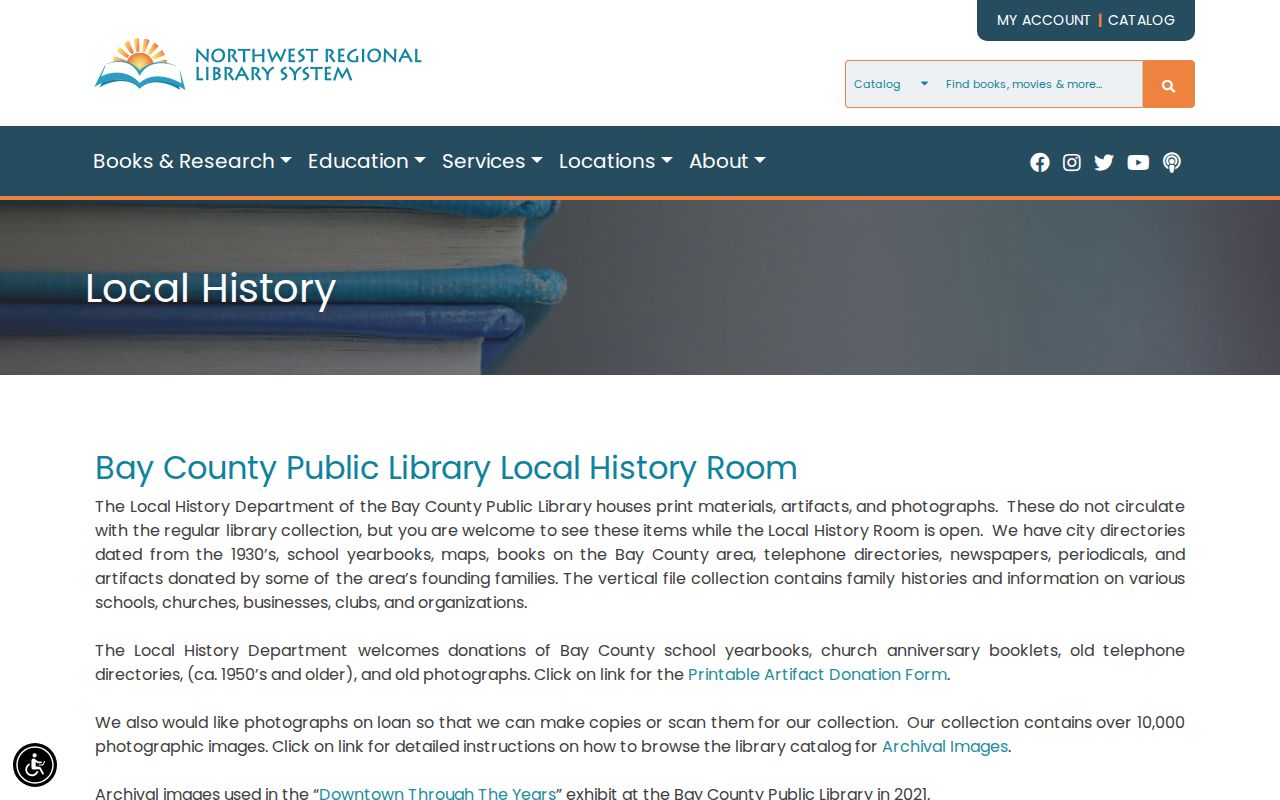
These source types can confirm a name in a school, congregation, firm, or neighborhood context without pretending that any one file is a complete resident roll.
The Bay County Genealogical Society contributes birth, marriage, obituary, cemetery, funeral-home, voter, and St. Andrews Messenger indexes. Its every-name Messenger index preserves about 1,501 entries from just six surviving issues, with about 700 names tied to one 1891 issue. Treat an index as a finding aid and obtain the underlying item before making a firm claim.
Panama City History Collections
The Historical Society of Bay County and Bay County History Museum collect documents and artifacts, present public programs, and support preservation research. An exact inventory and fee schedule were not published in the research, so contact the organization with a precise name, place, year range, and source already checked.
The Bay County history organization provides the public starting point for that inquiry.
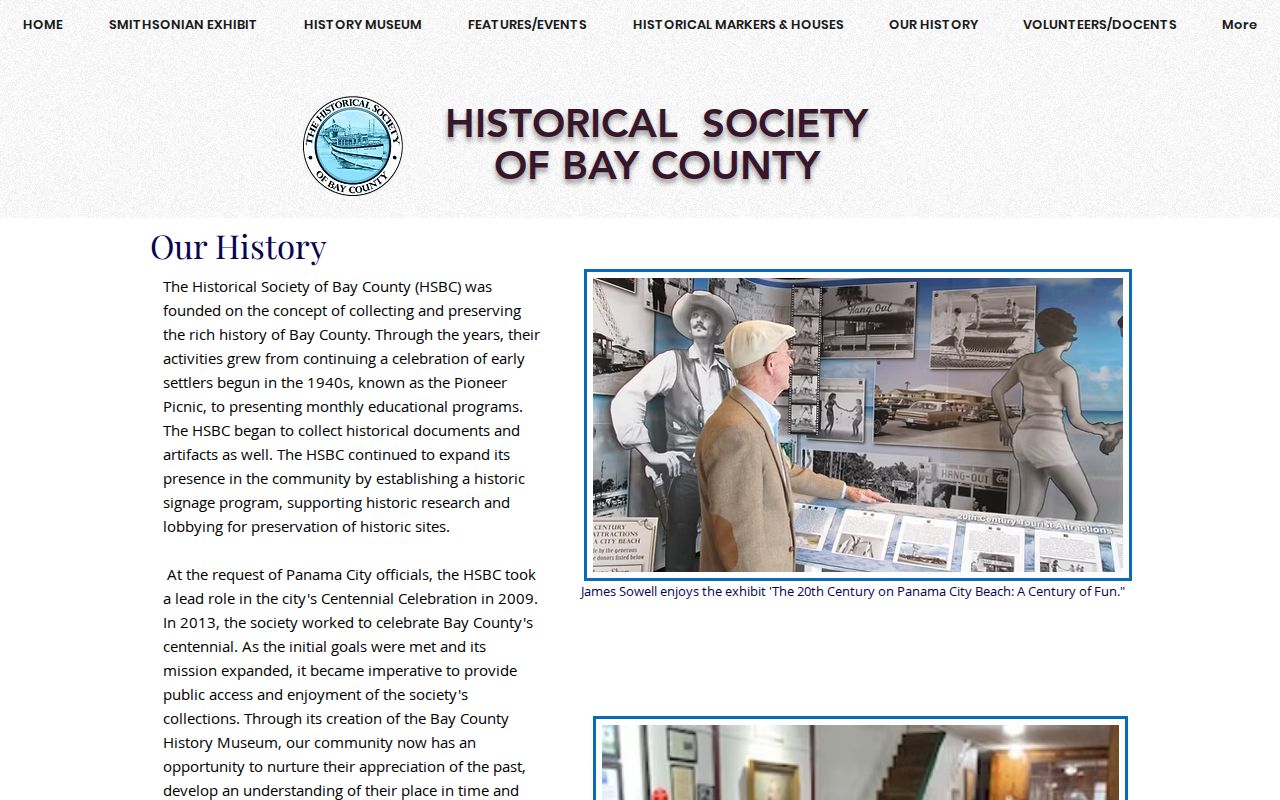
The museum route is best used after the library and digitized books define the gap, because a focused request gives staff a clearer person, address, or organization to test.
Verify Panama City Directory Finds
Directory publication year may lag the canvass, and an entry can remain briefly after a move. A person may be absent because the household was skipped, declined listing, used another spelling, appeared under a separate town, or left the area. Reverse listings identify a publisher's listed occupant or business, not every person who lived at the address.
For a modern address-keyed property trail, use the Panama City street directory search instead of stretching an old book beyond its date. For family history, cite the edition and page, compare adjacent years, pair open census schedules, and close important facts with an original newspaper, probate file, vital record, or other official source.
Source rule. A catalog entry proves a collection exists; only the page image or shelf volume proves what a specific city directory entry says.